For years, the story of biotech in Asia-Pacific was simple: growth. More jobs, more companies, more investment. But if you look closely at the market today, that narrative has evolved. The biotech and pharmaceutical job market across the region isn't just expanding—it's fundamentally restructuring.
Hiring patterns in Singapore, Australia, China, and beyond have shifted in ways that many job seekers haven't yet noticed, but employers are already acting on. If you work in R&D, clinical research, manufacturing, or regulatory affairs, understanding these structural shifts isn't just interesting—it's the key to positioning yourself for the next decade, not just the next job.
This isn't a list of trending roles. It's a look at the underlying forces changing the industry itself.
1. From Cost Center to Competitive Advantage: The New Manufacturing Mandate
Across APAC, pharmaceutical manufacturing is shedding its old identity as a back-end operational cost. The rise of complex biologics, cell and gene therapies, and biosimilars has turned production into a strategic differentiator.
In hubs like Singapore and South Korea, we're seeing a surge in demand for manufacturing professionals who understand that a deviation in a bioreactor can delay a global launch. The roles that are hardest to fill aren't just for technical execution, but for:
- Process optimization experts who can increase yield in biologics production.
- Validation leaders who can qualify complex new facilities for advanced therapies.
- Professionals who can integrate cross-border compliance strategy from day one.
If you're in bioprocessing or production, developing fluency in global regulatory expectations—not just running the equipment—can dramatically increase your career leverage. Explore current manufacturing roles across APAC.
2. The Blurring Line Between the Clinic and the Market
Gone are the days when clinical teams could operate in a bubble, focused solely on patient recruitment and data lock. In mature markets like Australia and Singapore, clinical development is becoming deeply intertwined with commercial strategy.
Sponsors are asking their clinical teams to think beyond the protocol. Clinical Research Associates and Trial Managers are now expected to have a working knowledge of:
- How trial design impacts market access and reimbursement timelines.
- The potential of regulatory acceleration pathways like Australia's Provisional Approval.
- How data collected today will feed into post-market strategy and payer negotiations tomorrow.
The clinical professionals advancing fastest into leadership aren't just great at monitoring; they're the ones who understand the business context behind the trial. Browse current clinical research opportunities.
3. Regulatory Affairs: From Gatekeeper to Growth Accelerator
This is perhaps the most profound shift. Regulatory affairs was traditionally seen as a final-stage gate, checking boxes before submission. In today's APAC landscape, it's a core strategic function.
Companies across India, China, and South Korea are now embedding regulatory experts earlier in the development cycle to map out the fastest, most efficient path to market. This means the demand has shifted from single-market specialists to professionals who can navigate:
- Harmonized submissions across multiple agencies.
- Fast-track pathways like those in China's reformed drug approval system.
- The strategic interplay between the FDA, EMA, PMDA, and TGA.
The regulatory professional who can design a global registration strategy from phase 1 is now one of the most valuable players in any biotech. Explore regulatory careers here.
4. The End of the "Niche" Data Role
For years, "bioinformatics" was a specialized corner of the industry. That era is over. Data skills are no longer optional; they are becoming foundational across every function.
This isn't just about hiring more data scientists. It's about the integration of data across the value chain:
- Clinical teams using real-world data and predictive modeling to design better trials.
- Manufacturing sites optimizing yield with predictive analytics.
- Regulatory teams navigating complex digital submission and eCTD systems.
Even non-technical professionals who develop strong data literacy—the ability to ask the right questions and interpret the answers—are becoming significantly more competitive. Browse data-driven biotech roles across the region.
5. The Mid-Level Squeeze: Where the Real Leverage Is
One of the most overlooked realities in APAC biotech hiring is where the true shortage lies. It's not at the entry level, and it's not in the C-suite.
The tightest, most competitive market segment is mid-level talent: professionals with 3–7 years of relevant, high-stakes experience. If you have deep expertise in:
- GMP environments and have seen an inspection through.
- Clinical operations and have managed a complex site.
- Regulatory submissions and have filed a dossier.
- Quality systems and have implemented a CAPA.
...you are in the hardest-to-replace, fastest-moving segment of the job market. If this is you, you have more leverage than you might realize.
6. The Rise of the APAC Biotech Professional
Biotech in Asia-Pacific is no longer a collection of isolated national markets. It's an interconnected ecosystem. A professional recruited in India might fill a critical manufacturing role in Singapore. An Australian regulatory expert might consult for a Korean CDMO.
This geographic fluidity means that professionals willing to see their careers in regional terms often accelerate their growth faster than those who stay put. The experience of navigating a new regulatory culture or building a team in a different market is itself a powerful career accelerant.
Explore opportunities by location:
- Singapore – The region's commercial and scientific hub.
- Australia – A global leader in early-phase clinical trials.
- China – A rapidly evolving market for innovative therapeutics.
- South Korea – A powerhouse in CDMO and advanced biologics.
- India – A growing center for clinical research and generics.
Rethinking Your Career Strategy
In a restructuring market, the old career questions stop being useful. Instead of asking "What jobs are trending?", the smarter questions are:
- Where is responsibility expanding in my field?
- Where is regulatory scrutiny tightening, and how can I become an expert in that?
- Where are the intersections forming—between clinical and commercial, data and decision-making?
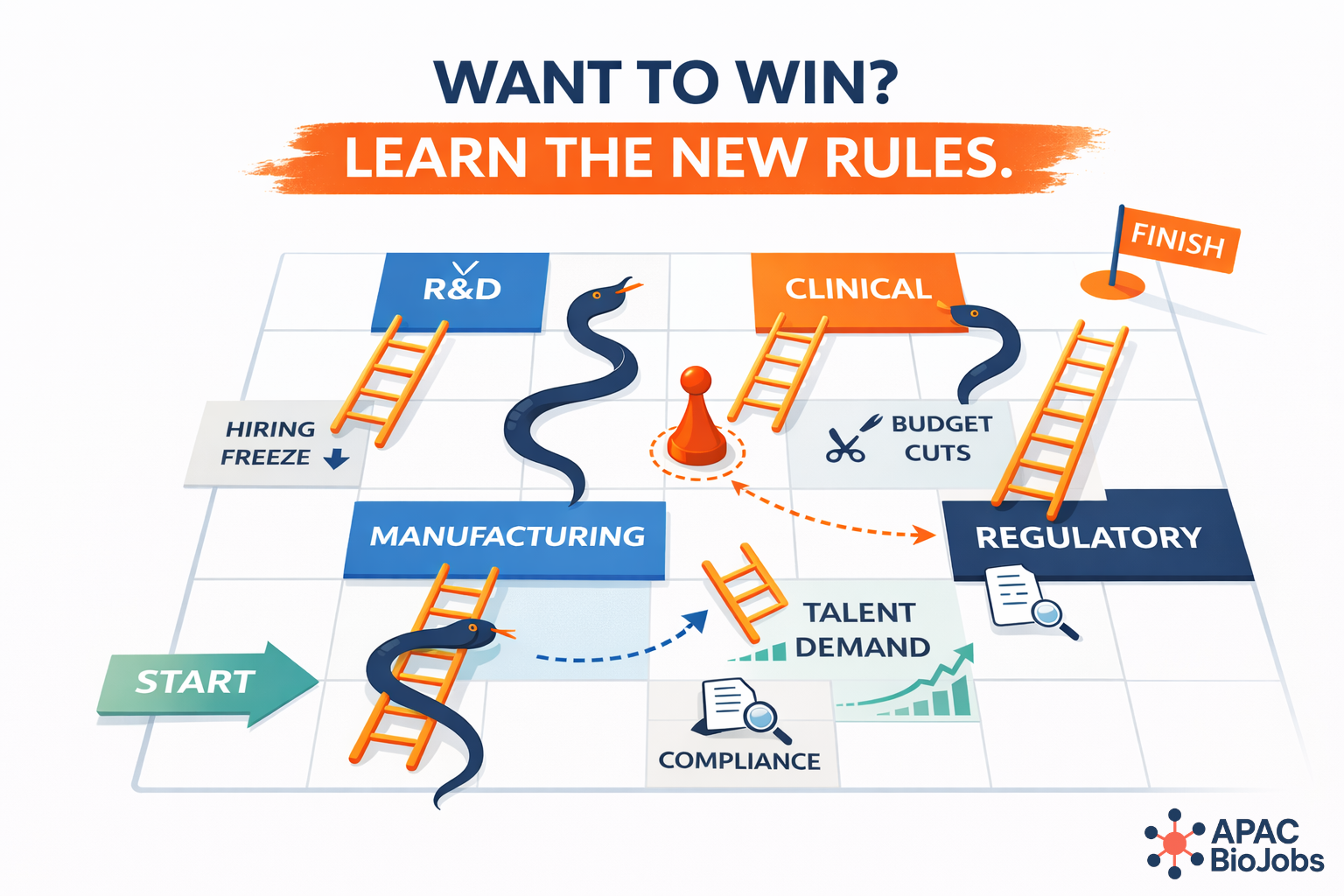
Those intersections are where career acceleration happens. The future of biotech jobs in APAC isn't just about volume; it's about integration. R&D with regulation. Manufacturing with compliance. Data with strategy.
The market is becoming more competitive, yes. But it's also becoming smarter. The professionals who understand these structural shifts—and position themselves at the intersections—aren't just finding jobs. They're building the future of the industry.
Explore current biotech and pharmaceutical roles across APAC.