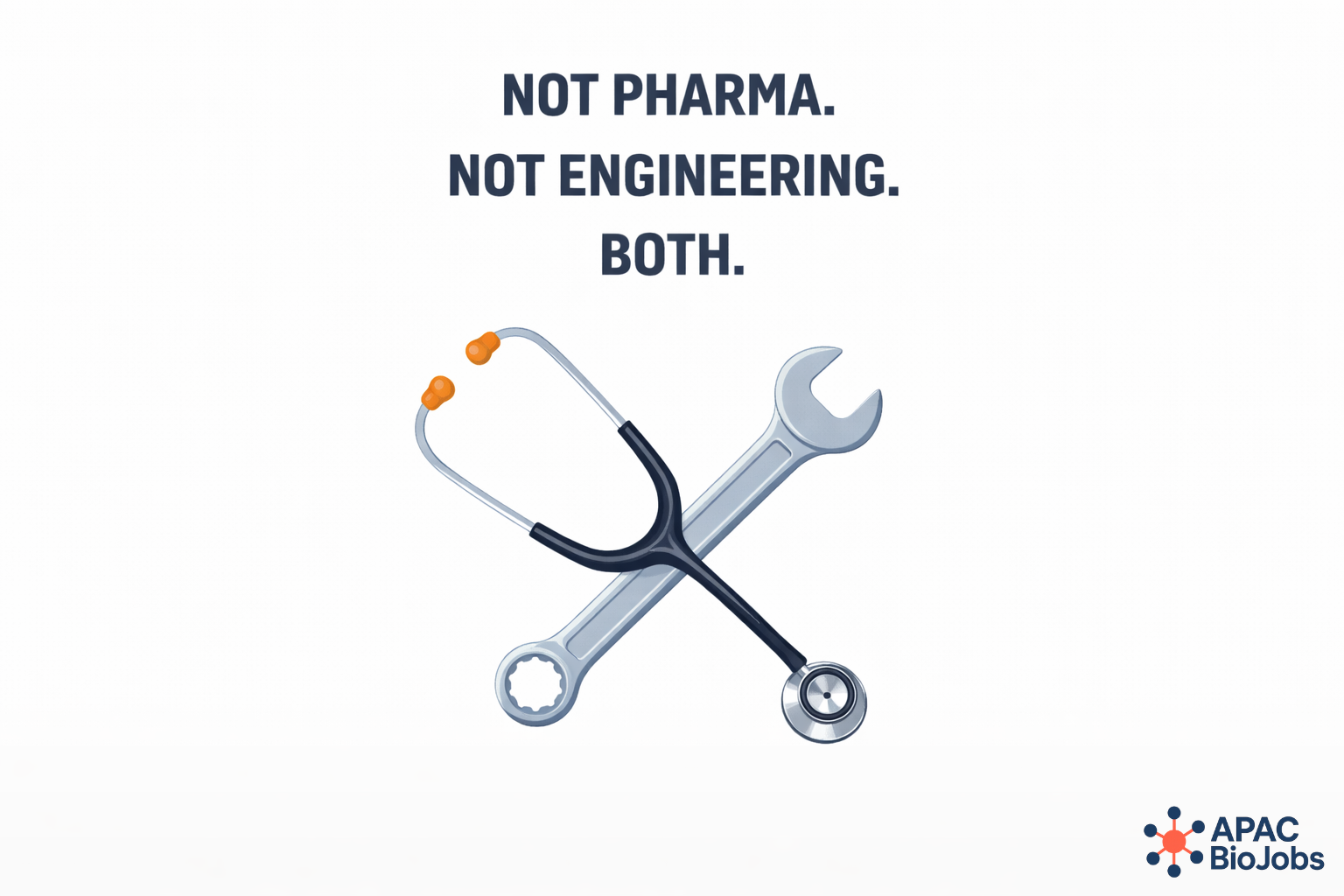
A lot of life sciences professionals assume that medical device jobs are just a variation of pharma or biotech work.
They’re not.
The medical device industry rewards a different kind of professional — one who can think not only about science or compliance, but also about systems, user interaction, design trade-offs, manufacturing reality, and real-world product performance.
That difference matters.
Because many candidates apply for medical device jobs using the same logic they would use for pharmaceutical or biotech roles. They emphasize scientific background, regulated experience, or healthcare exposure — all useful, but often not enough. Medtech hiring managers usually want something more specific: people who understand how a product actually moves from design to use, and how failure at any point in that chain can affect quality, safety, and adoption.
If you’re exploring medtech jobs, medical device careers, or broader medical device industry jobs in APAC, this guide explains what makes the field different, what hiring managers really look for, and how to position yourself more effectively.
What Medical Device Jobs Actually Involve
Medical device jobs span a wide range of functions across the product lifecycle.
Depending on the company and product type, roles may involve:
- product design and development
- design controls and technical documentation
- validation and verification
- risk management
- manufacturing scale-up
- quality systems
- regulatory submissions
- post-market monitoring
- field application and product support
This is one reason the sector is so attractive: it offers both technical depth and broad cross-functional exposure.
Unlike many pharmaceutical roles, where teams may stay more separated by function, medical device careers often require close coordination between engineering, quality, regulatory, manufacturing, and commercial teams. That makes medtech a strong environment for professionals who want to grow beyond narrow specialization.
Explore current Medical Devices & MedTech jobs here:
https://apacbiojobs.com/jobs/medical-devices-medtech
Why MedTech Hiring Managers Think Differently
This is where many candidates misread the market.
A pharmaceutical employer may prioritize clinical evidence, regulatory strategy, or therapeutic area depth.
A medical device employer is often assessing whether you can operate inside a more integrated product environment.
They care about questions like:
- Do you understand how design decisions affect manufacturability?
- Can you think about failure modes before they happen?
- Do you understand usability, not just technical performance?
- Can you work inside strict documentation systems without losing speed?
- Do you know how quality, engineering, and regulatory choices affect each other?
In other words, medtech often rewards systems thinkers more than function-first specialists.
That does not mean deep expertise is unimportant. It means expertise alone is not always enough.
The Most Common Types of Medical Device Jobs
The industry is broader than many candidates expect. “Medical devices” can include diagnostics, respiratory systems, surgical tools, monitoring devices, wearables, implantables, imaging systems, and digital health technologies.
Product Development and Engineering
Many medtech jobs sit in engineering-led environments. These roles may include:
- mechanical engineers
- biomedical engineers
- systems engineers
- product development engineers
- validation engineers
These professionals help design, test, and refine products while balancing performance, safety, usability, and manufacturability.
Quality Assurance and Quality Control
Quality is central in the device industry.
In medtech, quality is not just a final checkpoint. It influences product design, change control, traceability, complaints, CAPA, and inspection readiness.
Related quality roles:
https://apacbiojobs.com/jobs/quality-assurance-control
Regulatory Affairs and Compliance
Medical device regulation often differs significantly from pharma. It requires understanding classification, technical files, design history, labeling, and market-specific approval routes.
Related regulatory roles:
https://apacbiojobs.com/jobs/regulatory-affairs-compliance
Manufacturing and Operations
Many medical device industry jobs involve production scale-up, process control, validation, and supply continuity.
Related manufacturing roles:
https://apacbiojobs.com/jobs/manufacturing-bioprocessing
Commercial and Clinical Support
Medtech companies also need people who can bridge product knowledge and field use, including:
- clinical application specialists
- product specialists
- field service engineers
- device-focused commercial roles
Related commercial roles:
https://apacbiojobs.com/jobs/commercial-sales-marketing
Why Candidates Fail in MedTech Hiring
This is where the article becomes more useful than a standard overview.
Many strong applicants do not fail because they are underqualified. They fail because they signal the wrong kind of value.
Here are some of the most common mistakes.
They talk only about technical execution
Candidates often describe what they built, tested, or documented — but not how their work affected product quality, usability, compliance, or manufacturing outcomes.
They treat devices like generic engineering products
Medical devices are not just engineered products. They are regulated products used by clinicians, patients, or operators in real-world contexts. Hiring managers want to see awareness of that difference.
They underestimate documentation and traceability
Some engineering candidates sound strong technically but seem resistant to structured design controls, formal review systems, or documentation discipline. In medtech, that is a serious concern.
They ignore user interaction
A technically elegant solution that is confusing, error-prone, or hard to use is not a strong medical device outcome. Candidates who overlook user context often appear incomplete.
They don’t show cross-functional maturity
If you only speak in the language of your own discipline, you may struggle. The industry values people who understand how engineering, quality, regulatory, and operations fit together.
That’s one reason candidates from pure pharma environments sometimes struggle in medtech interviews. They may understand regulation deeply, but not product lifecycle thinking.
What Skills Matter Most in Medical Device Careers
The strongest candidates in medical device jobs usually show a combination of technical ability and product judgment.
That often includes:
- design control awareness
- risk management thinking
- validation and verification understanding
- quality systems knowledge
- structured documentation habits
- cross-functional communication
- comfort working with change control
- practical understanding of manufacturing impact
For more technical and cross-functional device roles, these skills are often more useful than broad life sciences experience alone.
Why APAC Is a Strong Region for MedTech Careers
APAC is not one uniform medtech market, and that is exactly why it creates opportunity.
Different countries contribute different strengths to the regional ecosystem.
Singapore
Strong for regional leadership, regulatory, advanced healthtech, and strategic medical device roles.
https://apacbiojobs.com/jobs/in-singapore
Australia
Strong for clinical evaluation, research integration, product innovation, and medtech-commercial environments.
https://apacbiojobs.com/jobs/in-australia
China
Strong for manufacturing scale, domestic device growth, and commercialization.
https://apacbiojobs.com/jobs/in-china
South Korea
Strong for engineering-led innovation, diagnostics, electronics-healthcare crossover, and advanced production.
https://apacbiojobs.com/jobs/in-south-korea
Taiwan
Strong for precision hardware capability, device manufacturing, and technology-healthcare integration.
https://apacbiojobs.com/jobs/in-taiwan
Professionals who understand these differences make better career decisions than those who treat APAC as a single market.
Medical Device Job Market and Salary Reality
The market for medical device jobs in APAC remains strong, especially in product development, quality, regulatory, validation, and field-based specialist roles.
While compensation varies by country and specialization, a few patterns are consistent:
- engineering and validation roles tend to command competitive salaries in more advanced device markets
- quality and regulatory professionals often see stable long-term demand because of strong compliance requirements
- commercial and field application roles can grow quickly when tied to high-value products or specialist markets
- candidates who combine technical credibility with cross-functional awareness often progress fastest
In practical terms, medtech can offer a strong long-term career path not only because of salary, but because the experience tends to be highly transferable across product, quality, and leadership functions.
Are You a Better Fit for MedTech Than Pharma?
This is a useful question many candidates do not ask early enough.
You may be a better fit for medical device careers if you enjoy:
- solving product problems, not just scientific questions
- thinking in systems, not just functions
- balancing design, quality, and manufacturing constraints
- working with products that users physically interact with
- structured processes, traceability, and change control
- faster product cycles than traditional drug development
If that sounds more natural to you than long clinical timelines or therapy-area depth, medtech may not just be “another life sciences option.” It may be the better fit.
How to Position Yourself Better for Medical Device Jobs
If you want to stand out, do not present yourself as a generic life sciences candidate.
Present yourself as someone who understands medtech logic.
That means highlighting:
- design control or product development exposure
- validation and verification work
- CAPA, risk management, or quality systems experience
- understanding of how user needs affect product decisions
- collaboration with regulatory, manufacturing, or quality teams
- examples of structured technical documentation
A medtech-ready profile usually signals product awareness and control-minded execution — not just industry familiarity.
If you’re also improving your application materials, these guides may help:
- Resume guidance: https://apacbiojobs.com/blog/biotechnology-resume-examples
- Interview preparation: https://apacbiojobs.com/blog/pharmaceutical-job-interview-apac
Final Thought
Medical device jobs are often treated like a subcategory of healthcare employment. That undersells them.
The best medtech jobs combine technical problem-solving, product visibility, regulatory depth, operational realism, and direct user impact. They reward people who can think across design, safety, quality, and execution — not just within one box.
For the right person, that makes medtech one of the most strategically interesting parts of the life sciences industry.
If you’re exploring your next move, browse the latest medical device and medtech jobs across Asia-Pacific here: